How Does an Essential Oil Diffuser Work? In simple terms, an essential oil diffuser spreads tiny amounts of scented oil into the air. Depending on the diffuser type, it may use water, vibration, airflow, or another method to release the oil.
At first, a diffuser may look like a small machine that simply makes a nice-smelling mist. However, there is more happening inside it. A diffuser takes essential oil and changes the way it enters the room air. As a result, you can notice the scent without putting the oil directly on your skin.
Moreover, many people use diffusers to make a room smell fresh, create a relaxing atmosphere, or support a bedtime routine. However, an essential oil diffuser is not a magic health device. Essential oils are highly concentrated plant products, and they require care.
This guide explains How Does an Essential Oil Diffuser Work? in very simple language. We will look at the different diffuser types, what happens inside the machine, how water and oil work together, how long a diffuser should run, common mistakes, advantages, disadvantages, real-life examples, safety tips, and more.
Quick answer: Most water-based ultrasonic diffusers use high-frequency vibrations to break a mixture of water and essential oil into a fine mist. A small fan or the vibration itself helps move that mist into the surrounding air. Other diffusers use airflow, evaporation, or heat instead.
How Does an Essential Oil Diffuser Work? The Simple Answer
So, How Does an Essential Oil Diffuser Work? The answer depends on the type of diffuser you own.
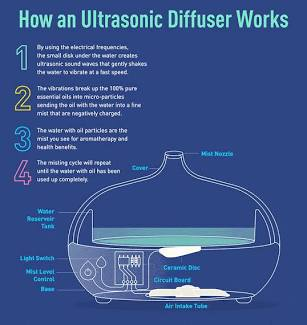
An ultrasonic diffuser usually has a small water tank. You add water according to the manufacturer’s instructions and then add a few drops of essential oil. Inside the machine, a vibrating plate moves at a very high frequency.
That vibration breaks the water-and-oil mixture into extremely small droplets. The device then releases those droplets into the room as a cool mist.
Therefore, you do not need to burn the oil.
Other diffusers work differently. A nebulizing diffuser uses airflow to break essential oil into tiny particles. An evaporative diffuser lets the oil slowly evaporate from a pad or wick. A heat diffuser uses warmth to help the oil evaporate.
The basic goal remains the same: move the aroma from the bottle into the surrounding air.
What Exactly Is an Essential Oil Diffuser?
An essential oil diffuser is a device designed to spread the aroma of essential oils into indoor air.
Essential oils come from plants. Manufacturers may extract them from flowers, leaves, bark, roots, seeds, peels, or other plant parts. For example, lavender oil comes from lavender plants, while lemon oil commonly comes from lemon peel.
Because essential oils are concentrated, people normally use only a small amount.
A diffuser provides one way to experience the scent without applying the oil directly to your skin.
Furthermore, diffusers come in many shapes and sizes. Some are tiny enough for a desk. Others have larger tanks designed for bedrooms, living rooms, offices, or other spaces.
Why People Want to Know How Diffusers Work
Many first-time buyers see a diffuser producing mist and wonder what creates it.
That question matters because different diffuser designs work in different ways.
For example, an ultrasonic diffuser uses water and vibration. A nebulizing diffuser usually uses no water. An evaporative diffuser depends on air movement. Meanwhile, a heat diffuser uses warmth.
Understanding these differences helps you choose the right product.
It also helps you avoid common mistakes, such as adding too much oil, using the wrong liquid, leaving water inside the tank for too long, or placing a diffuser where children or pets can reach it.
How Does an Essential Oil Diffuser Work Inside?
Now let’s look inside a typical ultrasonic diffuser.
Most ultrasonic models have several basic parts:
- Water reservoir
- Ultrasonic vibrating plate
- Small electronic control system
- Mist outlet
- Outer cover
- Power connection
- Timer or control buttons
- Sometimes a small fan
First, you fill the tank with water.
Next, you add the recommended number of essential oil drops.
Then, you turn the machine on.
The ultrasonic plate begins vibrating at a very high frequency. Those vibrations disturb the water and oil mixture and create a fine mist.
Finally, the mist rises through the outlet and spreads into the room.
In other words, the diffuser does not simply “spray perfume.” It uses a physical process to create a fine airborne mist.
The Water Tank Has an Important Job
Water plays a major role in many popular diffusers.
When you add essential oil to water, the oil does not truly dissolve into the water like sugar dissolves into tea. Instead, the oil forms tiny droplets within the mixture.
The ultrasonic system then creates a mist from that mixture.
Therefore, the water helps the diffuser create the mist that carries the aroma.
However, you should not assume that more water means better results. Always follow the tank’s fill line and manufacturer’s directions.
Too much water can reduce performance or cause the machine to spill.
The Tiny Vibrating Plate Does the Hard Work
The vibrating plate is one of the most important parts of an ultrasonic diffuser.
Although you cannot usually see it working, it vibrates extremely quickly.
Those vibrations create tiny droplets from the water-and-oil mixture. The droplets are small enough to move through the air as mist.
This explains why many ultrasonic diffusers operate quietly.
Instead of using a loud motor to spray liquid, the device uses high-frequency vibration.
For comparison, medical ultrasonic nebulizers also use high-frequency vibration in certain designs to create a mist, although medical nebulizers and aroma diffusers have very different purposes and should not be treated as interchangeable devices.
How Does an Essential Oil Diffuser Work Without Heat?
One reason ultrasonic diffusers became popular is that they can create a cool mist.
They do not need a candle or open flame.
Instead, electronic energy drives the ultrasonic plate.
That makes the basic process very different from burning essential oils.
Still, “cool mist” does not automatically mean “risk-free.” Essential oils remain concentrated substances. You should also keep the diffuser away from children, pets, flames, and areas where spilled water could cause damage.
What Happens to the Essential Oil?
This is where many beginners become confused.
The essential oil does not simply turn into steam.
Water vapor and an oil-containing mist are not the same thing.
In an ultrasonic diffuser, the machine creates tiny droplets from the water-and-oil mixture. Those droplets move into the room air.
As the droplets move and the water evaporates, the aromatic compounds can spread through the surrounding environment.
The exact behavior depends on the diffuser, oil, room temperature, humidity, airflow, and other factors.
How Does an Essential Oil Diffuser Work With Different Oils?
Different essential oils have different smells and physical properties.
For example:
- Lavender has a soft floral scent.
- Peppermint has a strong, cool-smelling aroma.
- Lemon has a bright citrus scent.
- Orange has a sweet citrus scent.
- Eucalyptus has a strong herbal scent.
- Tea tree has a sharp herbal aroma.
Because oils differ, you may notice that some scents seem much stronger than others.
Therefore, you should not automatically add more drops when an oil smells weak.
Your nose can also become less sensitive to a smell after continued exposure. This can make you think the diffuser has stopped working even when fragrance remains in the air.
The Four Main Types of Essential Oil Diffusers
Before buying a diffuser, learn the four common styles.
| Diffuser type | Main method | Uses water? | Heat? | Main feature |
| Ultrasonic | High-frequency vibration | Usually yes | No | Cool mist |
| Nebulizing | Air pressure/airflow | No | No | Concentrated oil delivery |
| Evaporative | Airflow and evaporation | No | No | Simple design |
| Heat | Warmth and evaporation | Usually no | Yes | Quiet operation |
The table gives you the basic picture. However, each type has different strengths and weaknesses.
How Does an Essential Oil Diffuser Work When It Is Ultrasonic?
Ultrasonic diffusers are among the most common home models.
They normally use water plus a few drops of essential oil.
The internal ultrasonic plate vibrates rapidly. Those vibrations produce a fine mist.
Then, the mist moves out through the top of the device.
This design can also add some moisture to the air because the diffuser uses water. However, an essential oil diffuser should not be confused with a dedicated humidifier.
A humidifier’s main purpose is to add moisture to indoor air. A diffuser’s main purpose is to spread aroma.
How Does an Essential Oil Diffuser Work When It Is Nebulizing?
A nebulizing diffuser takes a different approach.
It does not need a water tank. Instead, it uses airflow to break essential oil into very small airborne particles.
Because it does not dilute the oil with water, the aroma can feel stronger.
However, stronger does not always mean better.
You may need less operating time, and the oil supply can run out faster.
Moreover, people who are sensitive to strong smells may prefer a gentler diffuser.
Evaporative Diffusers Use a Simple Idea
Evaporative diffusers are easy to understand.
You place essential oil on a porous pad, wick, or similar material.
Air moves across the material.
As a result, volatile parts of the oil evaporate and enter the surrounding air.
This design does not require a water tank.
However, scent strength can change as different components evaporate at different rates.
Heat Diffusers Use Warmth
Heat diffusers use warmth to encourage essential oil to evaporate.
Some products use a warm surface, while older aromatherapy practices may involve other forms of heat.
However, caution matters.
Essential oils can be flammable. Children’s Hospital of Philadelphia advises keeping essential oils away from fire or flame and specifically cautions against heating oils with direct flame.
Therefore, a modern electric design with controlled warmth is very different from placing oil over a candle flame.
How Does an Essential Oil Diffuser Work in a Bedroom?
A diffuser can change the smell and feel of a bedroom within a short time.
For example, imagine a person who finishes work at 10 p.m. They clean the room, lower the lights, and use a diffuser with a scent they enjoy.
The diffuser spreads the aroma around the room.
As a result, the person may begin to associate that smell with bedtime.
This does not prove that the oil itself causes sleep. However, a relaxing routine can help create a consistent bedtime environment.
Cleveland Clinic notes that aromatherapy may be associated with benefits such as reduced anxiety and improved sleep quality, while also stressing appropriate use.
How Does an Essential Oil Diffuser Work in a Living Room?
Living rooms are often larger than bedrooms.
Therefore, scent may spread more slowly.
Room size, doors, windows, fans, air conditioners, and ventilation all affect how quickly you notice the aroma.
For example, a small diffuser may work well beside a reading chair but may struggle to create a noticeable scent throughout a large open-plan room.
So, choose a diffuser based on the manufacturer’s recommended coverage rather than simply choosing the biggest tank.
What Does the Mist Actually Look Like?
Ultrasonic diffusers often produce a visible white mist.
That mist can look like smoke, but it is not smoke.
It is a fine aerosol created by the diffuser.
This is why the mist may float upward and spread across the room.
However, the visible mist does not tell you exactly how much essential oil reaches the air.
A large cloud does not automatically mean more aromatherapy benefit.
How Does an Essential Oil Diffuser Work With Timers?
Many modern diffusers include timers.
Common settings may include:
- Continuous operation
- Short intervals
- One-hour timer
- Two-hour timer
- Automatic shutoff
- Intermittent mist
Timers are useful because they prevent unnecessary long operation.
For example, you might use a diffuser for a short period while relaxing rather than leaving it running all night.
Always follow your device’s instructions because operating times differ among products.
Why Diffuser Size Matters
A small diffuser may hold only a modest amount of water.
A larger model may hold much more.
However, tank size alone does not determine performance.
The diffuser’s mist output, room airflow, oil amount, and design also matter.
Therefore, do not assume a 500 mL tank will automatically outperform every smaller model.
Instead, look at the manufacturer’s coverage recommendation and operating instructions.
How Does an Essential Oil Diffuser Work With Room Air?
Room airflow plays a major role.
A ceiling fan can spread the aroma more quickly.
An open window can carry the aroma outside.
An air conditioner can move the scent through a larger area.
Meanwhile, a closed room may allow the scent to remain noticeable for longer.
For this reason, the same diffuser can feel strong in one room and weak in another.
How Does an Essential Oil Diffuser Work in a Small Room?
Small rooms usually need less output.
A powerful diffuser may create an aroma that feels too strong.
Therefore, start with the lowest recommended oil amount.
Then, adjust the operating time rather than immediately adding more oil.
This simple approach can help reduce waste and avoid overwhelming the room.
Choosing the Right Essential Oil
Your choice of oil depends mainly on the smell you enjoy and your reason for using aromatherapy.
Popular choices include:
Lavender: Often chosen for a gentle floral smell.
Peppermint: Often selected for its strong, fresh aroma.
Lemon: Popular for a clean citrus smell.
Sweet orange: A warmer and sweeter citrus scent.
Eucalyptus: A strong herbal scent.
Tea tree: A sharp, earthy herbal scent.
However, “natural” does not mean “safe for everyone.”
Some people may have allergies or breathing sensitivities. Essential oils can also cause harmful effects when misused. Poison Control warns that some essential oils can cause serious poisoning when swallowed and that allergic reactions can occur.
How Does an Essential Oil Diffuser Work With Essential Oil Blends?
You can also use blends.
For example, some people combine lavender with citrus oils.
Others combine peppermint with citrus scents.
However, beginners should keep blends simple.
Try one oil first.
Then, if you like it, add another.
This approach makes it easier to identify which scent you enjoy and which one may cause irritation.
The Right Oil Amount Matters
More oil does not always produce a better experience.
In fact, adding too much oil can make the smell unpleasant or overwhelming.
It can also increase exposure.
Therefore, follow the diffuser manufacturer’s instructions.
If the instructions recommend a specific number of drops per tank, start there.
Do not keep adding oil simply because you stop noticing the scent after several minutes.
CHOP notes that people can become less aware of a smell after continued exposure, which can lead them to add more oil unnecessarily.
How Does an Essential Oil Diffuser Work Safely?
Safe use starts with the product instructions.
First, place the diffuser on a stable, level surface.
Next, use the recommended amount of water.
Then, add only the recommended essential oil.
Afterward, close the device properly.
Finally, keep it away from children, pets, electrical hazards, and flames.
Also, never drink essential oil.
Essential oils are concentrated substances, and Poison Control warns that swallowing some oils can cause serious poisoning.
Cleaning Your Diffuser Is More Important Than You Think
A diffuser contains water.
Water can sit inside the tank.
Therefore, cleaning matters.
CHOP advises cleaning water-based diffuser containers daily because standing water can allow bacteria and mold to grow.
A simple routine can help:
- Turn off and unplug the diffuser.
- Empty leftover water.
- Wipe the tank.
- Follow the manufacturer’s cleaning instructions.
- Allow removable parts to dry as directed.
- Refill with fresh water before the next use.
Never use harsh cleaning chemicals unless the manufacturer says they are safe for that model.
What Happens If You Never Clean a Diffuser?
Over time, oil residue can build up.
The tank may develop a sticky film.
The mist output may also become weaker.
Furthermore, dirty standing water can create an unhealthy environment for microorganisms.
Therefore, cleaning is not just about keeping the machine looking good.
It helps maintain the device.
How Does an Essential Oil Diffuser Work With Different Water Types?
Water quality can affect diffuser maintenance.
Hard water contains minerals.
Those minerals may build up inside a diffuser over time.
Depending on the manufacturer’s instructions, filtered or distilled water may be useful for some models.
However, do not assume every diffuser requires distilled water.
Always check the product manual first.
Common Mistake: Adding Oil First
Some users pour essential oil into the tank and then add water.
Although this may seem harmless, the safer approach is to follow the manufacturer’s filling instructions.
Usually, you should not exceed the water fill line.
Also, you should not pour oil into areas of the device that are not designed to hold it.
If oil enters the wrong electronic area, it can damage the device.
Common Mistake: Running It All Night
A diffuser does not always need to run continuously.
Long operation may make the room smell too strong.
It may also use more oil and water.
Instead, consider using the timer or intermittent mode if your diffuser provides one.
CHOP’s guidance for children notes that room diffusers should run for 30 minutes or less at a time.
For adults, follow your device instructions and stop use if you notice irritation, headache, coughing, breathing problems, or other unwanted symptoms.
How Does an Essential Oil Diffuser Work Around Children?
Extra care is needed around children.
Essential oils are concentrated, and young children may be more vulnerable to harmful exposure.
CHOP recommends limiting aromatherapy for children and stresses that essential oils should never be swallowed or applied in pure form.
Therefore:
- Store oils out of reach.
- Keep bottles closed.
- Never let children play with a diffuser.
- Avoid direct skin contact with undiluted oils.
- Ask a healthcare professional before using aromatherapy for a child.
How Does an Essential Oil Diffuser Work Around Pets?
Pets deserve special consideration too.
Animals can react differently to airborne substances than humans.
Therefore, do not assume that an oil that smells pleasant to you is automatically safe for your pet.
Keep oils and diffuser liquids away from pets.
Also, provide good ventilation and allow your pet to leave the room.
If your pet shows unusual breathing, drooling, vomiting, weakness, or other concerning signs after exposure, stop exposure and contact a veterinarian.
Diffuser Safety for People With Sensitive Airways
People with asthma, allergies, or other breathing conditions should be especially careful.
CHOP advises people with conditions such as asthma and allergies to consult a healthcare provider before using essential oils.
Therefore, if a fragrance causes coughing, wheezing, throat irritation, chest discomfort, or breathing difficulty, stop using it.
Do not assume that increasing ventilation will always solve the problem.
How Does an Essential Oil Diffuser Work for Relaxation?
A pleasant smell can become part of a relaxation routine.
For example:
- Finish work.
- Clean the room.
- Turn down bright lights.
- Choose a favorite scent.
- Run the diffuser according to its instructions.
- Read or listen to quiet music.
- Turn the diffuser off.
The diffuser becomes one small part of the routine.
Cleveland Clinic explains that aromatherapy involves inhaling essential oil aromas and may support feelings such as relaxation or improved well-being for some people.
Still, aromatherapy should complement—not replace—proper medical care.
How Does an Essential Oil Diffuser Work for Sleep?
Many people use lavender or other calming scents before bedtime.
However, it is important to keep expectations realistic.
A diffuser cannot guarantee sleep.
Instead, it can become part of a consistent bedtime routine.
For example, someone might use the same gentle scent while reading every night. Over time, the smell may become associated with winding down.
That routine can feel comforting.
However, if you have ongoing sleep problems, speak with a healthcare professional rather than depending only on aromatherapy.
How Does an Essential Oil Diffuser Work for a Fresh-Smelling Home?
A diffuser can provide a pleasant scent without using a traditional aerosol air freshener.
You can choose different scents for different spaces.
For example:
- Citrus in a kitchen
- Lavender in a bedroom
- Fresh herbal scents in a bathroom
- A mild floral scent in a living room
However, a diffuser should not hide serious odors.
If your home smells musty, check for moisture, mold, plumbing leaks, garbage, or other sources.
A fragrance only covers an odor.
It does not fix the cause.
Real-Life Example: A Small Bedroom
Consider a simple example.
Sarah has a small bedroom with the door mostly closed. She buys a compact ultrasonic diffuser.
She fills the tank according to the instructions and adds a small amount of lavender oil.
Then, she sets the timer.
After a short period, she notices the aroma.
Instead of running the device all night, she turns it off before sleeping.
This example shows an important point: the diffuser does not need to operate continuously to become useful as part of a routine.
Real-Life Example: A Large Open Living Room
Now imagine David has a large open living room connected to a kitchen.
He uses a tiny desk diffuser.
After 30 minutes, he barely notices the scent.
He assumes the diffuser is broken.
However, the real issue may be room size and airflow.
The room has a ceiling fan, open windows, and an air conditioner.
Therefore, the aroma spreads and leaves the immediate area quickly.
David could try a diffuser designed for a larger space, but he should still follow the manufacturer’s oil and operating instructions.
Case Study: Why Cleaning Changes Diffuser Performance
Imagine two identical diffusers.
One person empties and cleans the diffuser regularly.
The other leaves old water and oil residue inside for days.
After several weeks, the second diffuser may develop buildup.
Its mist may become weaker.
The smell may also become unpleasant.
Meanwhile, the regularly cleaned diffuser continues to work more consistently.
This simple comparison shows why maintenance matters just as much as diffuser design.
Advantages of Using an Essential Oil Diffuser
There are several practical advantages.
Pleasant room fragrance
A diffuser can make a room smell the way you like.
Easy to use
Most models require only water, essential oil, and electricity.
Many scent choices
You can switch oils based on your preference.
No open flame in ultrasonic models
Ultrasonic diffusers create mist electronically rather than burning oil.
Timer options
Many models allow automatic shutoff.
Relaxing routine
A favorite scent can become part of a bedtime or relaxation habit.
Attractive designs
Many diffusers look like small home decor pieces.
Disadvantages of Essential Oil Diffusers
However, diffusers also have disadvantages.
They require cleaning
Water tanks need regular care.
Some people dislike strong scents
A fragrance that smells wonderful to one person may bother another.
Essential oils cost money
Frequent use can consume oil quickly.
Some oils can cause reactions
Sensitive people may experience irritation or breathing problems.
Pets and children need extra care
You cannot treat every essential oil as harmless.
A diffuser does not treat every health problem
A pleasant aroma is not the same as medical treatment.
Water can cause spills
A diffuser placed near electronics or furniture can create problems.
Essential Oil Diffuser Comparison Chart
Here is a quick comparison.
| Feature | Ultrasonic | Nebulizing | Evaporative | Heat |
| Water | Usually | No | No | Usually no |
| Heat | No | No | No | Yes |
| Mist | Yes | Fine oil particles | Usually invisible | Usually invisible |
| Oil use | Low to moderate | Often higher | Moderate | Moderate |
| Noise | Usually low | Can be noticeable | Low | Very low |
| Cleaning | Regular | Regular | Simple | Simple |
| Best for | Everyday home use | Strong aroma | Simple spaces | Quiet operation |
| Main concern | Standing water | Strong output | Uneven scent | Heat/fire safety |
This chart gives a basic overview. Product designs can vary, so always read the instructions for the exact diffuser you own.
Expert Advice: Start With Less
One of the simplest pieces of advice is to start small.
Do not begin by filling a room with a very strong scent.
Instead, use the minimum amount recommended by the manufacturer.
Then, see how you feel.
If you notice irritation, headache, coughing, or breathing trouble, stop using the oil.
Cleveland Clinic also recommends using small amounts because essential oils are strong.
Expert Advice: Buy From a Reliable Source
Quality matters.
CHOP recommends looking for product information such as the plant’s common and Latin name, plant part, country of origin, and extraction method.
Therefore, be careful with bottles that provide very little information.
A professional-looking label does not guarantee quality, but clear product information gives you more useful details about what you are buying.
How Does an Essential Oil Diffuser Work? Final Beginner Checklist
Before using your diffuser, check these points:
- Read the manual.
- Use the correct water amount.
- Use the recommended oil amount.
- Place the diffuser on a stable surface.
- Keep it away from children.
- Keep oils away from pets.
- Keep oils away from flames.
- Clean the water tank regularly.
- Do not swallow essential oils.
- Do not put pure essential oils directly on your skin.
- Stop if you experience unwanted symptoms.
- Ask a healthcare professional if you have a medical condition that may make aromatherapy unsuitable.
These simple steps can make diffuser use much safer.
Frequently Asked Questions
1: How Does an Essential Oil Diffuser Work?
How Does an Essential Oil Diffuser Work? Most ultrasonic models use high-frequency vibrations to turn water and essential oil into a fine mist. The mist then moves into the room air.
2: Does an essential oil diffuser make steam?
Not exactly. An ultrasonic diffuser creates a cool mist rather than boiling water and producing ordinary steam.
3: Do essential oil diffusers use water?
Many ultrasonic diffusers use water. However, nebulizing and evaporative diffusers generally do not need water.
4: How many drops of essential oil should I use?
Follow the instructions for your diffuser. Do not assume that more oil produces better results.
5: Can I run my diffuser all night?
It depends on the model, but continuous overnight operation is not always necessary. Use the timer or intermittent setting when available, and follow the manufacturer’s instructions.
6: Are essential oil diffusers safe?
They can be used safely when you follow the product directions and take appropriate precautions. However, essential oils can cause harmful reactions when misused.
7: Can I drink essential oils?
No. Essential oils should not be swallowed unless a qualified medical professional specifically directs their use in a medically appropriate product. Poison Control warns that some essential oils can cause serious poisoning when swallowed.
8: Can I put essential oil directly on my skin?
Do not apply pure essential oils directly to your skin unless a qualified professional has specifically advised an appropriate use. Many oils should be diluted first.
9: Can children use essential oil diffusers?
Children require extra caution. CHOP recommends special limits and safety measures for aromatherapy in children, and it advises keeping oils away from children.
10: Can pets be around a diffuser?
Pets can be sensitive to airborne substances. Therefore, use caution, provide an escape from the room, and ask a veterinarian about specific oils if you are unsure.
11: Why does my diffuser stop making mist?
Possible causes include low water, incorrect water level, oil buildup, a dirty vibrating plate, blocked openings, or a technical problem.
First, turn the device off and follow the cleaning instructions.
12: Why can I no longer smell my diffuser?
Your nose may have become less sensitive to the aroma.
Therefore, do not immediately add more oil. CHOP specifically warns that reduced awareness of a scent can lead people to add more oil unnecessarily.
13: Can a diffuser replace a humidifier?
No. A diffuser and humidifier have different main purposes.
A humidifier aims to increase indoor humidity.
A diffuser mainly spreads fragrance or essential oil.
14: Does a diffuser purify the air?
You should not assume that a normal essential oil diffuser purifies indoor air.
Its primary function is to disperse aroma.
If you want cleaner indoor air, address ventilation, dust, smoke, moisture, and other indoor-air sources directly.
15: Can I use perfume in an essential oil diffuser?
Generally, no. Do not put perfume, alcohol, fragrance oil, or other liquids into a diffuser unless the manufacturer specifically says the product supports them.
Use only the liquids the device was designed for.
16: Can I use tap water?
That depends on your diffuser.
Some manufacturers allow tap water, while others recommend filtered or distilled water.
Therefore, check the manual.
17: Why does my diffuser smell bad?
Old water, oil residue, mineral buildup, or poor cleaning can cause unpleasant smells.
Empty the tank and clean it according to the manufacturer’s instructions.
18: Is a nebulizing diffuser stronger than an ultrasonic diffuser?
A nebulizing diffuser can produce a more concentrated aroma because it does not dilute the essential oil with water.
However, stronger aroma is not automatically better.
19: Can a diffuser help me sleep?
A diffuser may become part of a relaxing bedtime routine, and aromatherapy may support relaxation for some people. However, it should not be viewed as a guaranteed treatment for sleep problems.
20: What is the best diffuser for beginners?
For many beginners, an ultrasonic diffuser is easy to understand because it uses water, a small amount of oil, and simple controls.
However, the best choice depends on room size, cleaning preferences, desired scent strength, and whether you want a water-free system.
External Resources for Further Reading
If you want reliable information about essential oils and aromatherapy, these resources are useful:
- Children’s Hospital of Philadelphia — Aromatherapy Safety — Practical information about aromatherapy, children, essential oil safety, and medical concerns.
- Poison Control — Essential Oils: Poisonous When Misused — Explains poisoning risks, safe storage, allergic reactions, and misuse of essential oils.
- Cleveland Clinic — Aromatherapy — Provides medical information about aromatherapy and different ways people use essential oils.
- Cleveland Clinic — Essential Oils 101 — Covers common essential oils, how people use them, and basic precautions.
How Does an Essential Oil Diffuser Work? The Bottom Line
So, How Does an Essential Oil Diffuser Work? It depends on the diffuser design.
An ultrasonic diffuser uses high-frequency vibration to create a fine mist from water and essential oil. A nebulizing diffuser uses airflow to disperse oil without water. An evaporative model relies on evaporation, while a heat diffuser uses warmth.
The most important point is that a diffuser does not magically change essential oil into harmless air. It disperses aromatic substances into your environment.
Therefore, use your diffuser carefully.
Start with a small amount of oil. Follow the manufacturer’s instructions. Clean the tank regularly. Keep oils away from children and pets. Never swallow essential oils. Also, stop using a scent if it causes irritation or breathing problems.
Most importantly, think of a diffuser as a tool for fragrance and personal atmosphere, not as a replacement for medical treatment.
When you understand the technology and use it responsibly, a diffuser can become a simple part of your home routine.